There have been several recent articles regarding accelerationism, for instance here and here. My own work on the topic led to a chapter coming out here. Material that did not fit into that document was then rewritten in the following article (posted here), sent to Critical Terrorism Studies for review, with me as a first author. This article was rewritten and resubmitted by the second author, “though the final text was single authored,” which you can now find here, with preliminary articles here and here that draw on the fundamental thesis of the original work, namely the convergent evolutionary tendency to attack infrastructure that activists across the political spectrum had taken up.
Feral Insurgents and Wild Reactions:
Civilization, Collapse, and the Infrastructure of Accelerationist Terror
A calloused coldness, or meanness, results when our animal senses are cut off for too long from the animate earth, when our ears—inundated by the whooping blare of car alarms and the muted thunder of subways—no longer encounter the resonant silence, as our eyes forget the irregular wildness of things green and growing behind the rectilinear daze.
-David Abram
“The way I see it, sins are only sins when unleashed upon a world that doesn’t deserve it…But now, when the world is so ugly and itself unclean, how can you consider action against it as sin? I would go as far to claim that action meant to collapse this place sooner, effectively making way for new life, would be considered holy—maybe even ordain able by a kind of state-aware papacy”
– Mike Ma,
Harassment Architecture (2019) pg. 46
I can’t sit by and watch my people get slaughtered. Screw your optics, I’m going in” (Gessen, 2018)
-Robert Bowers,
on far-right social network Gab,
before committing the deadliest attack on the Jewish community in U.S. history.
Looking Forward
We expect cell-based, clandestine networks to increase their focus on disrupting and damaging key infrastructure accessible to those with relatively low levels of technical proficiency (i.e., soft or under-guarded targets). Whereas networks of the past few decades may have focused more on spreading uncertainty and terror within radicalized, ethnic, religious and other communities, in their current strategic formulation, there appears to be a recent focus away from identity-based targeting and towards the disruption of key systems of governance and resource distribution. While past eras of terrorism were distinguished by communicative value–the fear and terror their actions communicated to secondary audiences like racial groups– we suspect current networks will focus on exploiting and advancing existing cleavages and social tensions, catalyzed by and contributing to breakdowns in industrial infrastructure, political-economic structures, and wider climate and ecological systems.
It appears clear that regional, national, and global crises will increase in frequency, scale, and intensity and that such crises contribute to increased human conflict, even civilizational collapse. Crises of climate, resource conflicts, public health, armed conflict, migration, and incidents involving mass casualty violence act as confirmatory indicators that radical action is needed and indeed required to survive. Moreover, these crises, from species decline to viral pandemics, point to shared forms of structural violence, triggering actions from a variety of revolutionary ideologies and interpretations who see such crises as openings for action, with violence begeting more violence as successful attacks prove the viability and accessibility of the approach for others, prompting the desire to accelerate new attacks. As crises and crisis response become the normative mode of statecraft, these groups may act more frantically, with greater daring, resulting in reduced regard for the protection of life.

Image: Graphic circulated on Telegram channel during COVID-19 pandemic.
In this paper we link crime to the infrastructure underlying current trends and perceptions of socioecological collapse to better consider anti-systemic terror. To do so, we consider the wider socioeconomic and technological mode of production that characterize and generate the very grievances against which resistance movements and accelerationist terrorists across the political spectrum set themselves. We then suggest alternative resolutions to psychological and physical crises such political violence attempts to address more suited to reducing political violence by enacting structural and systemic transformation guided by a framework of peace ecology.
Civilization as an Assemblage of Crime
Environmental harm and social stratification characterize modern society, generating the structural conditions that produce crime. As green criminologist Rob White writes in Crimes Against Nature (2008), “social tensions and ecological crisis are inevitably outcomes of the dominant mode of production globally.” The state-corporate nexus deploys violence against the natural world by design, in turn prompting anti-capitalist non-state subcultural resistances. In this regard, a green cultural criminology provides theoretical foundations for understanding ecologically motivated political dissent, positing resistance as responding to primary and secondary (symbiotic) environmental harms.
The human-nonhuman relationship, defined within the logic of capital (endless accumulation), transforms landscapes with particular purpose: “wherever primary commodity production penetrated, however, the tempo of landscape transformation accelerated.” Globalization, neo-colonialism, and the imperial expansion of capital remake the world system accordingly (“a dominating metropolitan centre ruling a distant territory”), reifying and reproducing structural violence, so that radical criminologies have approached crime as conscious or unconscious actions taken on behalf of subjugated classes. Because capital accumulation is contingent on hyperindustrial infrastructural innovations needed to maintain accelerating economic growth, the assemblages and systems necessary to maintain this open-ended growth invite a counter-infrastructural insurgency, or “brisantic politics” that characterizes future resistances. This “paradox of infrastructural brutalism” exemplifies the accelerating suicidal tendencies of capital, cascading towards self-annihilation.
The conceptual sensitivity we gain from such analyses prompts our exploration of specific antisystemic communiques by various individuals and groups, whose experience of structural and organizational conditions converge in emergent anti-infrastructural praxis, characterized by the moral imperative to attack the hierarchies of power that generate suffering. In this regard, an inductive and discovery-oriented approach integrating critical inquiry deepens analysis of terror, allowing explicit testing and explanation of the nature of such anti-systemic, anti-infrastructural insurgent actors.
Fed-posts or Shit-posts?
The desire to strike at key infrastructure, as when the neo-Nazi accelerationist network Atomwaffen Division (AWD) sought to blow up power lines and bomb a nuclear power plant, is recurrent within online discussions amongst accelerationists. One Telegram exchange showcases the desire to attack electrical infrastructure, when a moderator posts: “At this point the waiting and capitulation is getting to the point of lazyness, if you arent doing your part what the fuck are you doing.” This charge is responded to:
CUT
LINES
USED
FOR
TRANSMISSION
OF
ELECTRICITY
Minutes later, a second author writes, “Hey kid, you know only about ~17% of arson cases are solved?,” answered by the original poster:
BURN
TRANSFORMERS
USED
FOR
TRANSMISSION
OF
ELECTRICITY
The rhetoric escalates: “Imagine if someone opened fire on a nitrogen based fertilizer plant with incendiary rounds.”
Such comments demonstrate a common delivery style within the “Terrorgram” community, inciting attacks through faux warnings. In the context of COVID-19 restrictions, a user declares, “In quarantined areas, Electricity is the highest priority [REDACTED], if someone were to target a station in California New York, Washington, Italy, Germany, or France, I am certain there would be riots.” The ‘imaginative exercise’ of considering such attacks is repeated across channels:
I hear some people are buying Dexpan in cash, finding cracks in infrastructure, and over time filling those cracks. I hear it’s readily available at large hardware stores. I also hear that Dexpan and other demolition grouts can have ‘blowouts’. I hear that this condition is easy to create by mixing large amounts of it and cramming it into large cracks. ABSOLUTELY DO NOT DO THIS. IT WILL EXPLODE.
Here, the instruction and encouragement of attacks, cloaked in faux-warnings, offers ideas and inspiration to potential saboteurs. Likewise, an author shares a chart of household chemicals which when combined, produce toxic and corrosive acids and gasses with the caption, “definitely do not mix these together.” Comments on real-world sabotage provide more scenarios, made hyper-poignant in the wake of the pandemic: “definitely don’t do this,” a user writes, linking to an article about how six ambulances had holes drilled into their tires.
This tongue-in-cheek tone is recurrent in the accelerationist lexicon. In his book Harassment Architecture, a frequent addition to “required reading” lists for accelerationists, author Mike Ma employs this same approach:
why not funnel your nihilism into something absurd and productive. You don’t care about this place? Wonderful. Take a rifle and empty one entire drum magazine into the windows of AAA. Empty the magazine and don’t look back unless everything in that hornet’s nest is contaminated with lead. You don’t care about anything? Let me write a message about something that pains me, tape it to your chest, and send you into AAAAAAAAA for a memorable public self-execution. Let me cover you in plastic explosives and take you on a field trip to the largest power station in America. (Please note: Do not do any of these things. Especially do not cover your face and destroy the many and largely unprotected power stations and cell towers…Do not become the sort of person who gets really good at blowing power stations up while never getting caught.)
In this passage, Ma clearly advocates for not only unbridled mass shootings, but suicide bombings targeting power stations, using the paraenthetical aside to imply the faux warning method. Ma continues this approach throughout the book, using the ‘I hear some people’ approach showcased in the Dexpan grout posting:
I hear some people are buying extension ladders, going up on various store roofs, and pulling the disconnects on their heating and cooling devices…buying tennis rackets and hitting medium-sized pebbles into wealthy and ethnic neighborhoods, from extremely far distances away. I hear some of the pebbles are smashing Escalade sunroofs, McMansion mega bay windows, and more. I hear nobody can figure out where it’s coming from…buying machetes in bulk and leaving them next to the homeless while they sleep…learning how to build handheld EMPs on the internet and shutting off people’s electronics in secret…buying burner phones and calling ambulances to places, over and over…throwing screws in news station parking lots…getting jobs and immediately quitting…feeding journalists completely false stories and making them look bad…putting caution tape across busy streets and highways…running through car dealerships and smashing the windshield out of everyone on the lot at night I hear some people are hiding bluetooth speakers in places and broadcasting racial slurs at full volume…making homemade explosives and knocking down cell towers…making homemade explosives and disintegrating local power substations…stealing construction machines and driving them into lakes.
While the sarcastic, tongue-in-cheek warnings clearly identify and advocate pathways towards social tension and disorder, it is also clear accelerationists are parroting the call. Not only are calls to ‘Read Harassment Architecture’ frequently circulated online (alongside calls to ‘Read Siege’), the explicit recombination of accelerationist neo-Nazi activism and Ma’s text are frequently repackaged in memes.
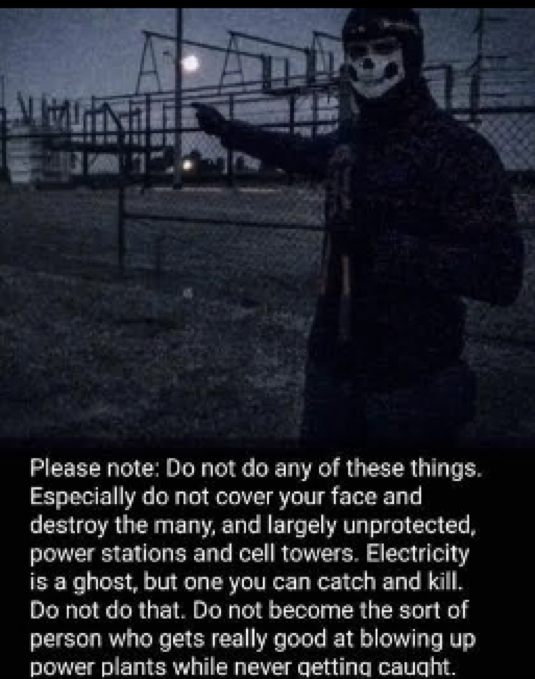
Image: Siege-masked accelerationist with bolt cutters stands in front of electrical infrastructure, captioned with text from Harassment Architecture
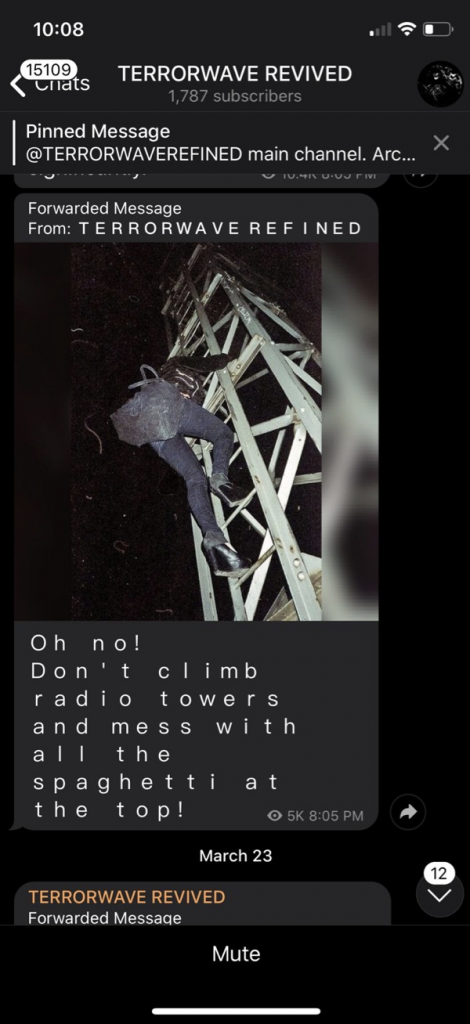
Image: Telegram post showing aforementioned practice
Whether telling people not to fill cement cracks with explosives, fire incendiaries into electrical infrastructure, or knock over cellular towers, the cumulative effect is a collective anti-social brainstorm–an ever-growing list of ways to foster, perpetuate, and extend chaotic disorder, not unlike the fictional proto-fascist patriarchal army “Project Mayhem” that attacks modern civilization through vandalism, sabotage, and homemade bombs, remaking the image of manliness from passive consumer into violent survivalist.
Prior white power movement texts like The Turner Diaries, operationalized by Federal building bomber Timoth McVeigh, similarly provide open-source blueprints for targets and a prolonged, multi-year strategy. In this regard, such literature “gamifies” attacks, borrowing and weaponizing cyberbullying and harassment tactics from the gaming community for far-right real world violence.

Image: Telegram post showing the gamification of right-wing mass shootings as scoreboard

Image: Site of Christchurch, NZ terror gamified in first-person shooter perspective
In March 2020, the FBI disrupted a plot to bomb a hospital with a vehicle-borne improvised explosive device amid the Coronavirus pandemic, determining the suspect “was a potentially violent extremist, motivated by religious, racial, and anti-government beliefs.” Indeed, he posted on various telegram channels, suggesting the attack was part of the wider accelerationist copycat echo chamber. Another man with similar neo-Nazi interests was arrested after allegedly planning an attack on an electrical substation, while others, like the former Canadian Armed Forces reservist connected to the neo-Nazi accelerationist group The Base, sought to derail trains, poison water supplies, and open fire on a gun rights rally with the intention of starting a civil war. Power substations and transformers, water filtration plants, nuclear reactors, propane storage facilities, suspension pylons, and other critical infrastructure have all been previous targets for white revolutionaries.
Moreover, to promote these goals, accelerationists attempt to create favorable contexts for left-wing groups, deep green luddites, neo-Nazi occultist-tinged militants, and bomb-deploying eco-extremists alike to proliferate:
There is no greater priority than achieving the goals of Accelerationism. Its purpose to us and to our collaborators is to create an environment for Radicalism (Fascism, Nationalism, Anarchist, Communists, Regionalists, and any fringe radical belief) to become common place.
In what follows, we outline examples of the varied networks’ targeting of infrastructure, reviewing the groups within an emerging taxonomic framework. In each case, the desire to precipitate social collapse through structural breakdown, social disorder, antagonism, and what leftists term “social war” creates conditions for a shared, if contradictory, approach to insurrectionary action against modern society, itself understood as a source of suffering, intending to inspire real-world events.
Anti-Civilizational Tendencies
The obvious sage of targeting critical infrastructure is Theodore Kaczynski (“the Unabomber”), whose 17-year bombing campaign targeted individuals involved in the production and maintenance of the ‘techno industrial system.’ During his bombing campaign, not only did Kaczynski dispatch explosive devices to university staff and faculty, scientists, executives, a computer retailer, and a lobbyist, he also targeted mass air transport infrastructure, placing a device on a Chicago to D.C. American Airlines flight, an office of Boeing in Washington, and one device successfully injuring the President of United Airlines. In Kaczynski’s view,
There is no way of reforming or modifying the system so as to prevent it from depriving people of dignity and autonomy. If the system breaks down the consequences will still be very painful. But the bigger the system grows the more disastrous the results of its breakdown will be, so if it is to break down it had best break down sooner rather than later.
Compare to oft-quoted American neo-Nazi James Mason, whose newsletters for the National Socialist Liberation Front were edited as Siege: The Collected Writings of James Mason, “required reading “ for many accelerationist groups:
To destroy the System is primary. To destroy the System without destroying ourselves is desirable. But with the System destroyed a new Age of Man can begin. Until the System is destroyed, by whatever means necessary, none of these fine plans will ever amount to anything more than a dream.
While the above theorists are explitly anti-leftist, Aric McBay, anti-fascist and co-founder of the radical feminist and environmental group Deep Green Resistance, writes similarly: “industrial civilization cannot last forever; the question is whether anything will be left once it is gone. The sooner collapse happens the better for the planet and those who live after.”
Nor is the desire to resist civilization by attacking infrastructure restricted to males, but includes women of the far- and post-left as well. Natasha Alvarez, in her novella Liminal, outlines a mother’s strategy to protect her child from the “death throes of a globalized, technologically driven civilization”:
Find the weak points. The factories and oil rigs, the transformers and the grids, the levees and the dams, the refineries, coal mines, gas mains, and government buildings. The banks. The million different pieces that make the whole thing tick. Aim for property destruction, not people…Figure out the weak points, the bottlenecks in the system. Plan an action, invite someone else to do the same…Finally it’s just you. Alone. Wedding ring on slender finger, photo of your blond haired baby daughter tucked close to your heart, and the smooth, cold steel of explosives strapped against warm and milky breasts. Woman, made weapon.
Such attacks align to what her green anarchist publisher terms, “the primal war,” attacking structures of “domestication”: power lines and transformers, telephone and fiber optic cables, pipelines and the natural gas industry, uranium mines, aqueducts and nuclear generation stations, self-driving cars, hacks on electric grids and the “internet of things,” attacks on police, universities, professors, researchers, journalists, non-profits, technologists, and corporate executives are all detailed, “for educational purposes only.”
Overlap between these insurgent worldviews is showcased by The Green Brigade, an international eco-fascist organization promoting themselves on Telegram as
an organization consisting of openly accelerationist, Eco-Extremist members focused on tearing down the system that exploits our land, animals, and people. These individuals prioritize and practice an autonomous environmentalist lifestyle, with a fascist emphasis and with a hatred for modern civilization.
Claiming responsibility for the arson of a mink farm in Sweden and disbanded in the wake of arrests of members of accelerationist group The Base, their imagery shows an individual with their face overlaid with a Nazi-era totenkopf, indicating allegiance with Siege-centered accelerationism, and holding Kaczynski’s well known manifesto, Industrial Society and its Future.


Images: Two graphics from The Green Brigade. Left image shows combination of Nazi-era totenkopf skull masked by a Norse, Proto-Germanic Algiz rune commonly used by post-WWII Nazis (when swastika was banned), holding Kaczynski’s manifesrto, Industrial Society and its Future (ISAF).
A number of Telegram channels similarly combine national socialist, eco-fascist, deep ecology, eco-extremist, and accelerationist quotes, memes, videos, manifestos, and newsworthy events, promoting groups ideologically conflicted to their own, including Earth First!, Earth Liberation Front (ELF), Animal liberation Front (ALF), Individualidades Tendiendo a lo Salvaje (Individualists Tending Toward the Wild) (ITS), Deep Green Resistance (DGR), etc. through commentary on attacks by ecological, anarchist, right wing, and anti-civilization theorists.

Image: Telegram image from eco-fascist channel The Green Brigade, showing classic Kaczynski FBI sketch combined with ‘Siege culture’ accelerationist skull mask.
Groups like ITS actively embrace the title of “wild terrorists,” claiming bomb attacks on scientists and technologists, mining and tech executives, and other “hyper-civilized” agents of modern society. Writing in one communique:
We despise their routines, their norms and morality. We reject equality, human progress, tolerance, science, collectivism, Christianity, pacifism, modernity, and all of the other shit that reeks of civilized domestication…this civilization wants to eliminate our most wild instincts to impose on us its values that run roughshod over the individual…it wants us to consider this murder ‘evil,’ even though it is a result of a war without morality. May Eco-extremism and terrorist nihilism increase in Mexico, Chile, Argentina, Italy, and other places. With Wild Nature on our side.
Thus eco-extremism, a term popularized with ITS, itself attacked by anarchists for exhibiting crypto-fascist tendencies, may exist precisely as this meeting point where imagery from neo-Nazi occult satanism finds its way into anti-civilization discourse.

Image: Posting to Telegram accelerationist channel showing Order of Nine Angles (O9A)imagery

Image: Satanic imagery alongside 09A symbolism in eco-extremist literature.
In a posting to a eco-fascist Telegram channel for instance, the author overlays onto a dark forest scape the text “SUPPORT TO ECO-EXTREMISM” and follows with, “Hail to all Eco-Extremists around the world far and wide. For they are the true world builders. Hail to the ALF, Hail to ELF, Hail to Earth First![,] Hail to ITS, Hail to The Green Brigade, Hail to all others and lone wolves!” The statement indicates ideological markers are less important to modern actors, especially when an eco-extremist text, explicitly titled “Against the World-Builders” situates themselves thusly: “ITS aren’t a bunch of ex-anarchists tending towards fascism, but rather ex-radicals tending toward anti-social criminality.”
While at times those interested in ‘bringing it all crashing down’ may seem nondogmatic, ideologically incoherent, and actively invested in erasing differences and nuances between worldviews, these differences not only exist, but are a source of identity, even if they share common targets and orient themselves vis-a-vis the accelerating collapse of the system.
As such we offer five distinct corporea from ideologically-linked movement texts, each derived from key texts authored by, or circulated amongst a given milieu, alongside commonly recurring words to survey the discursive and textual intersections between movements advocating for collapse.
| Accelerationist | Right-Wing Shooters | Ted Kaczynski | Deep Green Resistance | Individualists Tending Towards the Wild | |
| Total word count | 620,251 | 813,362 | 206,589 | 759,275 | 92,836 |
| Most commonly occuring word* (rank) 1 | People (57th) | European (35th) | System (26th) | People (28th) | Wild (28th) |
| 2 | Time (64th) | Muslim (39th) | People (30th) | Resistance (53rd) | Attack (36rd) |
| 3 | System (72nd) | Muslims (45th) | Society (36th) | Other (55th) | Against (47th) |
| 4 | Other (76th) | Europe (46th) | Other (47th) | Power (65th) | Human (48th) |
| 5 | White (80th) | People (50th) | Movement (52nd) | World (72nd) | Mexico (49th) |
Table: Comparing five corporea for most frequently occurring words
*Excluding prepositions, pronouns, determiners and conjunctions. The (#) reports the word’s frequency rank within that individual corpus.
While the analysis is restricted to the most commonly-occuring words in a collection, even at this cursory level, we can identify important trends and clear intersections. The Accelerationist and Right-Wing Shooter collections show a focused discussion on in-group versus out-group distinctions, with accelerationists focusing on “system,” “other,” and “white,” and Right-Wing Shooters showing a starker focus on “Muslim(s)” and “Europe.” When compared to the more ecologically minded collections of DGR, ITS, and Kaczynski, we see the out-group expands beyond race and ethnicity to the social order–“people,” “society,” “power,” “world,” and “human.”
This linguistic survey may show a transition from critiques about demographics and identity towards system-level infrastructure and the political and economic systems generating those dynamics. This is seen in accelerationist discourse–“white” versus “system”–in Kaczynski–“people” versus “system”–in DGR–“people/resistance” versus “power”–and in ITS– “wild” versus “human.” Syncretism within accelerationist and anti-civilization discourse is further highlighted, as where Atomwaffen Division consider Kaczynski alongside Timothy McVeigh and Anders Breivik as a holy trinity, each “sainted,” alongside other shooters whose terrorist attacks are heavily promoted in circles.

Image: List of “Sainted” accelerationists, noting accelerating frequency of attacks
While these findings represent a superficial, birdseye engagement with the texts and movements authoring them, these overall frames are useful when contextualizing their more specific manifestations in the discussion that follows.
As there are meaningful differences between the groups, networks, and frameworks we present here, discussion of anarchist-situated ELF and primitivist-nihilist situated ITS alongside eco-fascists and other survivalist-centric parts of the racist radical right is somewhat awkward. Though we distinguish between various tendencies, others may not, and indeed nuances may be consciously or unconsciously eliminated to conflate otherwise contradictory ideological dispositions, uniting them under one banner. The tendency to synthesize worldviews to justify attacks on infrastructure is apparent; moreover, the corporea demonstrate the expanded political terrain and degree to which themes like deep ecology, decentralism, anti-modernism, anarchism, Indigenism, veganism, and the valorization of place, identity, traditional lifeways, state critiques, and transcendence of right/left dichotomies become open to co-option by groups organizing around otherwise contradictory principles.

Image: Graphic from Telegram channel self-described as “A group for National Socialist to discuss, learn, and share things related to Blood and Soil, and Deep Ecology.”
Decisive Ecological Warfare
The attempt to accelerate collapse through insurrection and terror is not limited to the far right, and includes milieus of radical environmentalists, green anarchists, deep ecologists, biocentrists, primitivists, and radical feminists like the network Deep Green Resistance (DGR), whose name is appropriated by a “nationalist environmentalism” telegram channel. In each case, the collapse strategy is anti-majoritarian, anti-mass, and seeks to increase tension, strain, and fatigue on the system, speeding up collapse rather than engaging in electoral politics. Many, like the armed wing of the white nationalist Northwestern Front, Pine Tree Gang, adopt the ideas and strategy of anti-technologist Kaczynski to actively accelerate collapse.

Image: Ted Kaczynski drawn in ‘saint’ style (title applied to ‘successful’ far-right mass shooters) posing in front of fascist Schwarze Sonne.
From a ‘supermax,’ limited communication prison in Florence, Colorado, where he is serving eight life sentences, Kaczynski states:
what has to be done is not try to persuade the majority of people that we’re right, so much as to try to increase tensions in society to the point where things start to break down, when people get uncomfortable enough so that they’re going to rebel. Now the question is how do you increase those tensions?
Elsewhere, he suggests five industries as critical targets for any anti-technological war against modern society, where “radicals ought to put in some time thinking how to hit the system where it really hurts. By legal means, of course.”
- Electro-power industry
- Communications industry
- Computer industry
- Propaganda industry
- Biotechnology industry
While green anarchists criticize Kaczynski’s essay for its authoritarianism and insufficiently considering resistance as an “outcome of spontaneous rage…[against] the civilized order, and most importantly a strike against domestication,” in the years following his capture and imprisonment, nonviolent clandestine networks of eco-saboteurs emerged globally, and in the U.S. gained notoriety in the late 1990s with the emergence of the Earth Liberation Front (ELF). ELF’s use of arson and relatively low rate of infiltration and arrests led to the FBI naming it the primary domestic national security threat, and while reported occurrences of so-called ‘eco-terrorist’ attacks have declined since a height in the early 2000s its influence remains widespread.
Drawing from the logic of these radical movements and others is DGR, whose strategic and analytical frameworks come from the works of American philosopher and activist, Derrick Jensen and occasional co-authors Lierre Kieth and Aric McBay. In their 2011 book by the same name, the three authors make explicit the strategy and aim of accelerating structural collapse and discuss a dual approach:
What if there was a serious aboveground resistance movement combined with a small group of underground networks working in tandem?…abovegrounders would work to build sustainable and just communities wherever they were, and would use both direct and indirect action to try to curb the worst excesses of those in power, to reduce the burning of fossil fuels, to struggle for social and ecological justice. Meanwhile, the undergrounders would engage in limited attacks on infrastructure (often in tandem with aboveground struggles), especially energy infrastructure, to try to reduce fossil fuel consumption and overall industrial activity. The overall thrust of this plan would be to use selective attacks to accelerate collapse in a deliberate way, like shoving a rickety building.
The authors write that attacks organized via decentralized networks of autonomous cells would “not be symbolic attacks…[but] serious attacks designed to be effective but timed and targeted to minimize the ‘collateral damage’ on humans.” They note strikes would target fossil fuel and electrical power consumption and involve reducing the availability of these resources to force a focus and investment in just, sustainable, and autonomous human communities and the recovery of subsistence bases.
In an “underground action calendar” on the group’s affiliated website, actions like pipeline attacks, cyberattacks on fossil fuel systems, and incendiary devices against freight rail networks are highlighted to “publicize and normalize the use of militant and underground tactics in the fight for justice and sustainability.” Through networking, organizing, and mobilizing aboveground and underground resistance, asymmetric attacks of sabotage are designed to disrupt essential systems and dismantle critical infrastructure:
- Financial systems
- Extraction infrastructure
- The energy grid
- Communications infrastructure
- Technology industry
Also included as targets are the system’s values: expansion, hierarchy, stability, efficiency, white supremacy, human supremacy, male supremacy, comfort, ignorance, consumerism, progress, and scientism. DGR’s advocates thus promotes as its basic goals, “to disrupt and dismantle industrial civilization; to thereby remove the ability of the powerful to exploit the marginalized and destroy the planet,” attacking and rejecting industrial civilization’s core structures and values, as where groups “destroy train tracks at critical intersections, rendering coal transportation impossible.”
In this regard, earth defense movements are encouraged to adopt “similar convictions of strategic rigor,” and coordinate “decisive attacks against multiple such nodes [that] will have an exponential effect, and can cause cascading failures within the system.” These infrastructural attacks by underground networks are thought to accelerate in frequency once evidence of collapse surfaces.
Attacks on energy infrastructure would become more common as oil supplies diminish…These attacks would steepen the energy slide initially. This would have significant economic impacts, but it would also turn the tide on population growth… [those in power] would use resistance as an excuse to seize more power to institute martial law or overt fascism.
Part of the job of the resistance movement is to increase the cost and decrease the returns of empire-scale complexity. This doesn’t require instantaneous collapse or global dramatic actions. Even small actions can increase the cost of complexity and accelerate the good parts of collapse while tempering the bad.
In his muli-volume Endgame series, Jensen argues for techno-industrial breakdown as a prerequisite for peace: “if these folks who are visualizing world peace really are interested in actualizing world peace, they should also be visualizing industrial collapse. And bringing it about.” Transcribing a discussion with a hacker about “bringing it all down,” Jensen writes:
I think that twelve hackers could take down the electrical grid of all of North America, a blackout lasting for months. That blackout itself would take out key components. Of course those in power would immediately start retooling, and because they have more resources than we do they’d eventually be able to come back online. We’d have to hit them again in the meantime.
DGR co-author McBay speaks of related strategies, writing:
…resistance networks decide to shut down entire distribution systems for oil, coal, or gas. This means, again, aboveground and underground organizations taking action and looking for bottlenecks…Aboveground groups might do that with physical blockades. Underground groups might sabotage rail lines. Both are careful to target infrastructure in a way that avoids harming humans.
The point of this stage is to accelerate the industrial collapse that will already be underway…While those on the front lines are shutting down the infrastructure that’s killing the planet, there is another, much larger group of people working to rebuild local, democratic political structures. They are growing local food. They are rebuilding sustainable communities with all that entails.
In this regard, varied attacks on infrastructure should not be seen as sporadic or stochastic, but integrated into a wider approach to an emerging and increasingly self-evident cross-cultural “accelerationist” strategy.
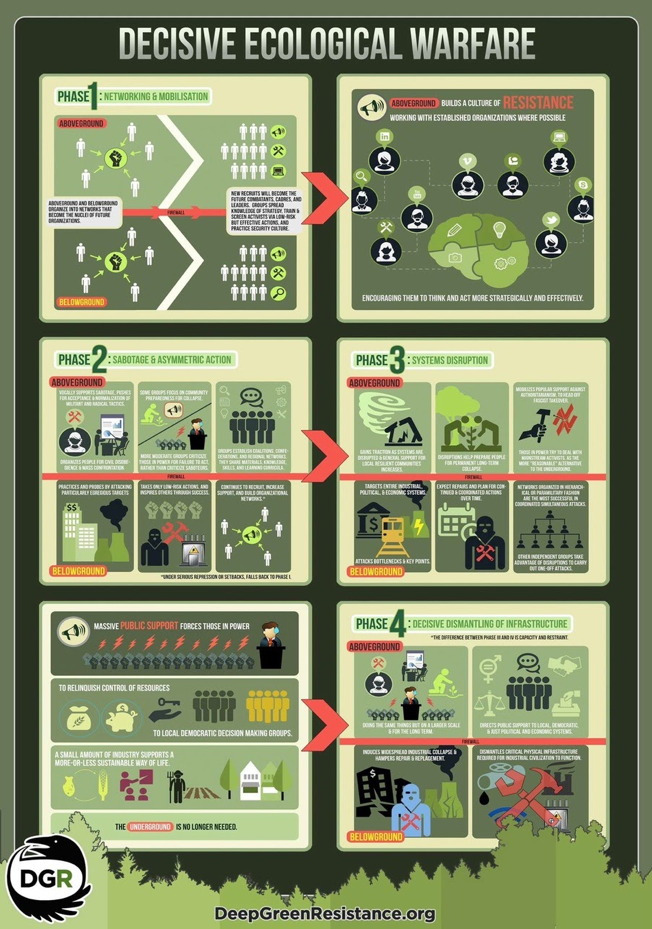
Image: DGR diagram explaining Decisive Ecological Warfare strategy (see URL in citation for high-resolution, text-readable version)
Infrastructure and Supply Chains: Cross-Cultural Targets
Despite the radical environmental movement’s focus on disrupting infrastructure, their aim diverges from the Siege-inspired far-right who fetishize igniting power stations for the sake of an emerging ethno-state. In ELF’s first communique, anonymous authors identified their role as the “burning rage of a dying planet…to speed up the collapse of industry, to scare the rich, and to undermine the foundations of the state,” by disrupting operations of targeted entities, cutting into profit margins of lucrative extractive industries, and forcing companies to pay to secure them.
Like DGR’s “underground action calendar,” ALF, ELF, and hundreds of lesser known unnamed actions are reported in carefully curated Diary of Action pages, such as those maintained by ALF/ELF supporters. As the Animal Liberation Front is more active historically than the Earth Liberation Front (beginning decades earlier), these incidents feature more heavily in targeting trends. Examining targeting patterns of the wider radical environmental movement frequently labeled “eco-terrorists,” the most commonly attacked target type (across 27,000+ incidents analyzed between 1973-2010) was retail stores, especially those selling fur and leather, constituting 19% of attacks. Following retailers, attacks targeted businesses selling animal-based foodstuffs (e.g., butchers, delis), farms, ranches, animal breeders, and restaurants serving animal products, intending to put them out of business, targeting the infrastructure of species exploitation and the mechanisms through which speciesism is violently enacted.
Famed animal liberation activist Peter Young speaks to the wider strategy, encouraging clandestine saboteurs to abandon targeting retail sites and instead locate and disrupt the systems and processes supporting those retailers:
I want to propose a new model for the ALF…The first element of strategy is to avoid small-scale sabotage. Go only for high impact actions…The second strategic element is that ALF actions should always go after weak links and vulnerable industries. Not nearly soft targets…target the infrastructure of industries, not the retail end…For every 100 McDonald’s there’s probably one meat distributor. For every 10 meat distributors, there’s probably one slaughterhouse. Think about how you can move up the chain and go to the source. How you can go after an industry’s infrastructure.
Young shifts the focus of ALF away from symbolic “soft targets” towards a focused disruption of animal industry infrastructure. While farms, ranches, breeders, and fast food storefronts may not appear as such when compared to the electrical grid or cellular towers, concerted attacks on both the retail and supply chains of animal agriculture provide a similar strategy for economic sabotage increasing the likelihood of the industry’s collapse. The strategy was made explicit in a series of publications authored by anonymously ALF supporters which mapped the fur industry’s supply chains, bottlenecks, and points of vulnerability through the distribution of detailed target lists and tactical, ‘how-to’ guidance.
When examining only the ELF in 700+ attacks across fourteen countries at the height of the network’s activity (1996-2009), attacks targeting automobiles (especially SUVs) and phone booths constitute more than 46% of the total incidents. Yet when examining single target incidents, the most commonly attacked ELF targets are construction and industrial equipment (14%), homes under construction and model homes (13%), and business properties (12%). These are followed by attacks targeting automobiles/SUVs (10%) and phone booths (8%), trends corroborated by other scholars and intelligence reports.
The degree to which radical ecological defense movements have been successful stems from the anonymity and decentralization each cell maintains. In this regard, movement recruiters focus on populating new cells rather than joining pre-existing ones, becoming the vision rather than joining those already in service. The North American Earth Liberation Press Office concurs with such a strategy writing (and repeated in a later recruitment videos):
How does one become a member of the ELF? The ELF does not have any sort of physical membership list or meetings you can attend to become involved. Remember, the ELF revolves around not a physical base or classically designed structure, but instead an ideology. If you believe in the ELF ideology and you follow a certain set of widely published guidelines, you can conduct actions and become part of the ELF…create [your] own close knit anonymous cell made up of trustworthy and sincere people. Remember the ELF and each cell within it are anonymous not only to one another but also to the general public. So there is not a realistic chance of becoming active in an already existing cell. Take initiative, form your own cell and do what needs to be done!
Though early propaganda of neo-Nazi accelerationist networks consistently advocated to “Join your local Nazis,” or “save your race join The Base,” a series of arrests due to recruitment of undercover agents or journalists may have swayed these groups to more fully operationalize this style of leaderless resistance.

Image: Recruitment poster for neo-Nazi survivalists, The Base
Days after American neo-Nazi and AWD-spiriritual leader James Mason announced the formal dissolution of the group, a splinter factor (or individual) published a ‘program’ for AWD:
To those still within the framework of this ‘movement’ or ‘mass-strategy’ program, this may be a bit hard to comprehend…Anyone on Earth can be ‘Atomwaffen Division’, for the premise is an operation that exists to antagonize within the framework of the group, with varied networks and resources…anyone with the appropriate self-determination can print their own fliers. Anyone can assemble a uniform, patch or mask. This cannot be stopped, and there is no reason to stop it. Atomwaffen Division has no ‘membership list; or ‘card carrying official membership’, therefore the operative is not a ‘member’.
Comparing this language to ELF aboveground supporters in 2001, the similarity is plain, mirroring white power activists such as Tom Metzger, former Klan leader and founder of White Aryan Resistance. Metzger’s strategic commentary strategy for “white lone wolves” was included as a central component of a 2017 AWD video released in the wake of the Charlottesville, Virginia rally:
You won’t see us at polling booths. You won’t see us at cluster fucks like took place in Virginia this weekend. We have been through that years ago and found it was not a viable tactic in combating our opposition…If I were to be inclined towards these ill thought out gatherings I would do it the opposite way, I would seek out my opposition’s meeting places and rallies and their homes and pay them a visit at our own opportune time…As far as parading for the press, we’re never going to do that. The struggle is going to take more time to develop for what you could call an insurrection or a civil war, it’s coming.
Across the ideological spectrum, anti-systemic groups are experimenting within similar organizational, tactical, and strategic approaches. For ELF, forming cells to act within a constrained strategic realm to economically sabotage targets by damaging property was always an objective. For AWD and transnational fascist cells, a similar movement towards a typology of action exists–adapting definitions of membership. If a cell cannot be joined, the responsibility to act reverts to the individual, the lone wolf, the network of leaderless resistance organized through “phantom cells,” or what post-9/11 jihadists termed Global Islamic Resistance.
Though radically divergent in their vision, rhetoric, and approach, networks like ELF and AWD share key goal-centric aspects. Neither desired to be a mass movement of followers per se, but rather a minoritarian movement engaged in attack–sabotage, vandalism, and arson by clandestine cells. These disparate attacks were linked to one another by movement spokespeople, inter and intra-movement publications, and collectively form a shared trajectory. Both networks want adherents to act, organize, and attack like them, without collectively organizing with one another into a known, named force. These networks do not desire majority participation, as Kaczyinski said, but rather affect the majority of the population, disrupting key systems and structures to undermine a common enemy.
While affinities between radical environmentalists, eco-extremists, and Kaczynski is well documented, as are connections between neo-Nazism and violent jihadism, the possibility for correspondence between ecological resistance movements and violent jihadi terrorism is also apparent. Osama Bin Laden, for instance, in an unsigned letter “to the American people,” calls for a “great revolution for freedom” to prompt political leaders to end the war on Islam and make “a rational decision to save humanity from the harmful [greenhouse] gases that threaten its destiny.” Speaking to “the West,” bin Laden writes of “the tyranny of the control of capital by large companies,” and for the American youth to understand and “relive the [revolutionary] history of their ancestors and the conditions in their country. Due to the commonality of targets and organizational capacity, Kaczynski considers the affinities between anti-civilization terrorists and Jihadis. Noting a rejection of modernity, he questions the extent to which “it might be useful to our movement to carry on discussions with the Muslim militants and see whether there is sufficient common ground there for any sort of alliance.”
As the infrastructure underlying extractive capitalist economy destabilizes traditional lifeways and ecological values, the resulting insecurity, factionalism, and securitization, a combined attack on the fundamental institutions and structures of modernity emerges: “when communities lack enough time to adapt to all the innovation and change, its members may fall short of their aspirations; anxiety and alienation bubble up, and violence can erupt along prevailing political and religious fault lines.” The insurrectionary accelerationism detailed above offers a corresponding ideology, driven by an economic mode that exacerbates global antagonisms to threaten peace and security. Anticipating socioecological collapse within the next decade, one accelerationist Telegram user comments:
This will come to pass in the 2020’s, and the deaths will be mainly focused in the 3rd world, as our resources will be put on hold, and the hand outs they use to supplement and over breed will dry up. Medicine, food, all will go away, and the 3rd world will empty for us to expand into…There will be a guerilla force in America that will outnumber the armies of the world. Knowledgeable vets, teamed up with angry young white men. The North American continent will shake with fear before you, and the sheep of the white left will worship you as their new master.
We suggest these expectations of race war stem from infrastructural constraints of the economic mode, systematically inducing its own collapse, evoking Robert Kaplan’s prediction of the threat nearly two decades ago:
Urban crime may…‘develop into low-intensity conflict by coalescing along racial, religious, social, and political lines.’ …future wars will be those of communal survival, aggravated or, in many cases, caused by environmental scarcity. These wars will be subnational, meaning that it will be hard for states and local governments to protect their own citizens physically. This is how many states will ultimately die. As state power fades—and with it the state’s ability to help weaker groups within society, not to mention other states—peoples and cultures around the world will be thrown back upon their own strengths and weaknesses, with fewer equalizing mechanisms to protect them. Whereas the distant future will probably see the emergence of a racially hybrid, globalized man, the coming decades will see us more aware of our differences than of our similarities.
Ecological Criminals and Collapse Criminology
If the dominant political and economic mode requires ecocide and exploitation, producing scarcity while inducing criminality, such harms and crimes are driven by the infrastructure that underlies it. As such, the state-corporate nexus and insurgent movements exist in dynamic tension:
Where there is domination, there is resistance to domination; where new forms of domination, new forms of resistance ultimately surge to act upon the specific patterns of domination…a growing number of activists have come to believe that ‘change will be brought about, not through the mediation of professional politicians, but by individual and collective participation in social affairs.
In confronting overexploitation and its social effects, anti-infrastructural resistance engages “hierarchically organized governments fostering and protecting social systems of stratification” by targeting the interface between any social system and natural principles, intending to realign them and resolve “the relentless struggle between the [irreconcilable] contradictions of consumer capitalism and efforts to maintain a clean and healthy environment” outside of legal means.
Movements willing to confront the unsustainable nature of modern society thus represent a rupture with the reigning cultural logic, threatening corporate power and those systems upholding that power. For these groups, embracing terrorism as a strategy for social change is an embrace of militant struggle against the perceived corruption of the state-corporate nexus, the inability to govern justly, and the commodification of beauty. Moreover, as electoral politics is similarly captured by this logic, there becomes no possibility for political solutions or voluntary transformation.
Drawing from our linguistic analysis, in-groups define themselves as existentially threatened by constructed out-groups, with retributive violence against them assumed necessary responses to resolve the existential crisis, conforming to J.M. Berger’s definition of extremism. Crimes of terror thereby signal grievances generated by the very socioecological and cultural contexts that produce them, signaling the desire for systemic and structural transformation where governance is perceived to have failed, and suggesting pathways addressing the underlying dynamics may be more effective than deterrence in countering violent extremism.
Ultimately, the accelerating rate of return on scales of economy, dependent on environmental degradation required by open-ended economic growth models systematically increases rates of disease, crime, even perhaps insurrectionary violence driven by these same underlying forces. Violent extremism, terror campaigns, and insurrectionary attacks seek to eliminate those structures; such crimes indicate unjust and alienating social conditions, grievances contingent upon the underlying dynamics generating scarcity, solastalgia, and the context for extremist belief systems and terrorist acts to proliferate. As far-right researcher Brian Hughes writes, the “emerging [accelerationist] eco-radicalism lies in the tangible, material experience of life under global capitalism in the age of eco-crisis…[searching] for a future beyond techno-capital’s calamitous success.”


Images: Memes circulated on Accelerationist Telegram channels and video sharing sites
We suggest an approach to terror then, where extremist violence and insurrection articulate a system-wide critique that rejects representative politics, attacks external threats with retributive violence, and seeks autonomy and liberation from a specific world-ecology and economic mode, “the system.”
A core category emerges from these various communiques we call “collapse criminology,” relating socioecological collapse, crimes stemming from collapse, and crimes seeking to precipitate collapse, all of which feedback into and catalyze one another..
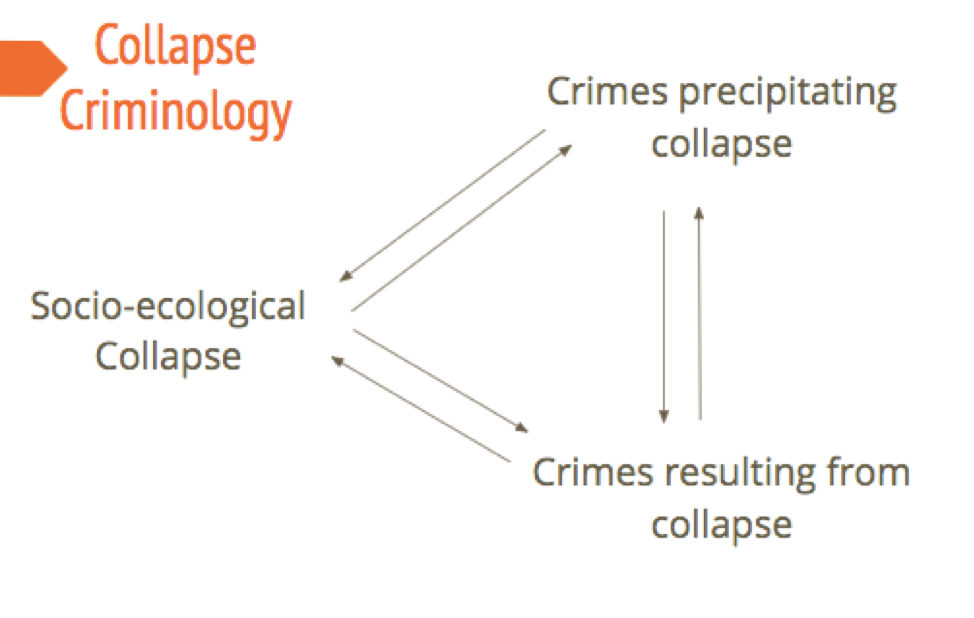
Chart: A theoretical model of collapse criminology, where dynamics of socioecological collapse provoke criminal acts that both consciously and unconsciously catalyze collapse in turn
In this framework, criminality, violent extremism, and accelerationist terror arise as a biosemiotic process where individuals and communities, facing existential threat, interpret surrounding environmental signals in mythological terms to guide (mal)adaptive strategies and evolutionary pathways. By linking crime to collapse, and attributing both to the infrastructure and economic mode undergirding the suicidal logic of the state-corporate nexus, criminal behavior is better understood as embedded within a “nested model of violent extremism,” where extremist networks and belief systems are themselves enmeshed in wider socioecological contexts. Crime then offers empirical measures of socioeconomic and psychocultural health, suggesting greater likelihood for terror where collective strains remain.
In this regard, effective preventative intervention requires “the coordinated delivery of services from numerous agencies, but these agencies [are] severely fragmented, resulting in ineffective preventative intervention.” That is, a sense of economic injustice is psychologically present where capacity for services is degraded; and in an era of environmental scarcity and climate chaos, increasingly so. Socioecological disorganization is thus assumed to induce crime where demographics, climate, and environmental scarcity exacerbate criminogenic mechanisms, leading to harms, intercultural conflict, and violence, including a breakdown in social order.
This breakdown of order stems from the structural composition of the “Treadmill of Production” (ToP), whose techniques “increased not only production but also pollution and raw material extraction. In this way, the drivers of ToP accelerated ecological disorganization and destruction, behaviors we have defined as green crimes from the perspective of the ecosystem.” Further, economic stratification and overexploitation of natural resources determines the lifecycle of any given society, the over-exploitation of either–structurally required for capitalism and industrial growth models—are independently found to result in societal collapse:
Oligarchic states tend to be politically unstable, environmentally destructive, and prone to collapse…[putting] unsustainable pressures on the social, economic, political, and ecological foundations of civilization...it is the relations of domination themselves, rather than the individual agents who enact them, that are the locus of systemic dysfunction.
Capitalism’s treadmill of production, accelerated by industrial infrastructure and capital accumulation, drives collapse, inequality, and scarcity, conditions that trigger criminogenic mechanisms, encouraging criminal behavior and increasing the likelihood for terrorism, extremism, and violence. Crime as an indicator of inequity and the failure of governance thereby signals an unjust social order against which criminality offers pathways to avoid sustained deprivation while challenging the legitimacy of a sociopolitical arrangement that rejects a fundamental cosmological principle: “operationally, those systems capable of utilizing optimum amounts of energy tend to survive, and those that cannot are nonrandomly eliminated.”
Sacred Narratives and a Cosmology of Terror
The degree to which a social order is rejected and delegitimated provides a marker of political and socioecological health, with insurrectionary violence signaling the desire for systemic change. Terrorism may be understood in terms of Marx’s ‘primitive rebellion’ thesis, where agents move against and within an untenable social form. This critical appraisal proceeds from the insight that, as Marx writes:
The mode of production in material life determines the general character of the social, political, and spiritual processes of life. It is not the consciousness of men that determines their existence, but on the contrary, their social existence determines their consciousness.
Infrastructural variables, as the principal interface between culture and nature whose energy restraints are “passed on to the structural and superstructural components,” become causal chains affecting cultural evolution. The mode of economic production in material life – technologies and techniques used to harness food and energy and exchange and distribute goods – in turn constrains the operations of social organizations, structures, and value systems, as well as the wider cosmology and worldview.

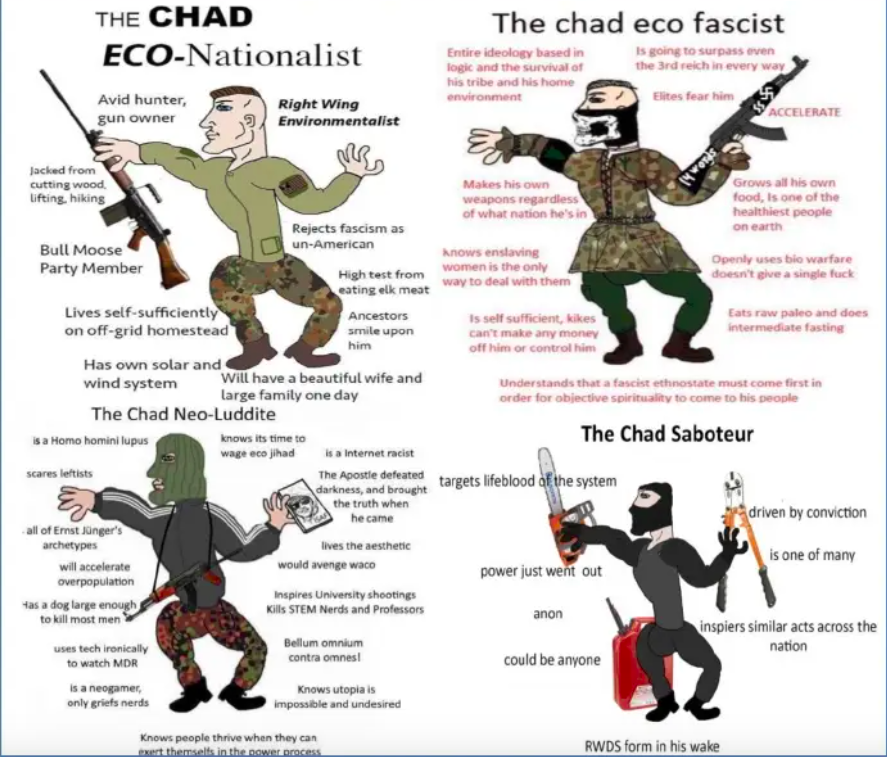
Image: Eco-fascist “Chad” memes circulated on Telegram channels
The effect is to render adaptive strategies virtually sacred, while making taboo (criminal) maladaptive behaviors antithetical to the infrastructural arrangement. Ideology, in this case a sense of the sacred, is thus a product of place, grounded in economic social function and projected into thoughts and feelings, experienced as ‘natural,’ at times ‘divine’ forces. Conversely, the phenomenological brutality and physical repulsion of the mode of production and economic base is similarly projected into the mind and will of constituent members, instilling disbelief in or the outright rejection of such infrastructures (and economic mode) “by people who have become intellectually and emotionally emancipated from the existing system.”
If thoughts are complex elaborations of what we do and how we feel, those techniques necessary for cultures to remain within the carrying capacity of a bioregion have a psychological correlate: adaptive relationships communicated in sacred narratives and ritualized organizational processes institutionalize social rules– survival imprints able to defuse external stressors and ensure cultural resilience. Yet when maladaptive structures or social norms themselves become recognized as existential threats, the social malfunctioning requires a re-establishment of rules. Hence the indispensable role of resource managers who assume traditional political or spiritual leadership, ensuring proper behaviors, exposing unrestrained resource exploitation, and correcting violations of community norms.

Images: Eco-fascist memes circulated on Telegram channels, promoting harmony with nature
Sacred narratives are thus organized around homeostatic survival functions used as the template for neural organization and cultural continuity. They offer a “mythobiology” of sorts, uniting cosmology, theology, and anthropology (“cosmotheanthropy”) so that by making sense of environmental signals, symbols able to situate the human community within a wider cosmological context establish and perpetuate ideal socioecological orders through appeals to the sacred: a “blueprint for ecological adaptation, positing worldviews as the organizing concept behind the cultural ecology of a group,” to facilitate “cooperative social behavior aimed at the conservation of ecological balance as the ultimate desirable quality.”
Similarly, infrastructure and social behaviors, initially institutionalized to maintain cultural resilience yet reinterpreted as maladaptive (degrading landscapes and communities), are delegitimized through attacks on power structures that articulate a system-level critique. The insurrectionist then attempts a similar ecological role as a resource manager, assuming political and spiritual leadership by drawing on environmental observations, collective memory, and personal experience to “cure a social malfunctioning” through violence. Sympathizers likewise read the landscape and communicate in quasi-religious terms their interpretations of existential threats, receiving and redistributing ecological interpretations in information hubs, authoring new attacks and critiques that flow through networks and feedback in self-reinforcing arenas.
We can then consider ideologically motivated violence as emerging from an environment pushed out of its psychological carrying capacity. In a sense, the wider ecosystem ‘acts through’ individual agents situated in deteriorating ecological contexts: the terrorist becomes a symptom of disorder, attacking the modern social structure designed to maintain stability, “the spontaneous suicide of the defense mechanism supposed to protect the organism from external aggression…itself working to destroy its own protection, to immunize itself against its own immunity,” a symptom “occurring within the system that should have predicted it.” In this way can we understand Mike Ma’s defense of accelerationism as an attempt to provide a kind of ‘social medicine’:
When I say ‘to accelerate’ or ‘to push forward’ or ‘to lean into’, I don’t mean towards a better world – not immediately at least. We are leaning into the collapse. We are pushing for the ignition of cleansing fire. I am acceleration and I am the reaction. This way nobody knows who’s doing what or why. I am the one dumping magazine after magazine into a crowded gay nightclub…I am the world’s fire and I am the world burning.
In this regard, insurrectionary accelerationism represents the desire for systemic transformation; and with it, the conditions needed to survive the unsustainable nature of exploitative relations, joining an active eschatology that engages the perceived concretized evil of civilization with redemptive violence. As such, we can suggest political extremism as an attempt at ecological criticism, with criminology as an opportunity to theorize (rightly or wrongly) about ecological resilience.

Image: Instructions for poison seed bombs ‘for the race’ including Siege imagery (black lightning bolt in red shield) and O9A imagery (seven-fold inverted star).
Peace Ecology and Structural Conflict
A peace-centric approach to conflict denotes “peace” as a social goal, rather than an absence of violence. Moreover, this peace studies framework notes a type of violence “built into the social structure,” requiring structural, system-level, emancipatory strategies and solutions. Structural conflicts are expressions of structural inequalities; structural violences, involving “inequality, above all in the distribution of power.” These violent inequities kill slowly and anonymously, obscured by cultural and ideological systems which “erase the history and consciousness of the[ir] social origins.”
This structural violence is best mitigated by fostering justice, equality, and peace (i.e. positive peace), rather than trying to reduce or avoid violence, inequality, and exclusion (i.e. negative peace). Only through intervening in these inequalities can we hope to alleviate the threat of violence spurred on by eco-anxiety and predictions of collapse. In critically examining the infrastructural deprivation and delegitimation produced in specific sociocultural contexts, structures directly producing violence as a necessary premise for socioeconomic organization can be identified, undermined, and transformed, no longer destabilizing peace processes by leaving intact those structures and arrangements that maintain nonreciprocal relations. Here, we recognize “conflict as a struggle to maintain or overthrow systems of domination.” As environmental philosopher Bron Taylor writes:
Only by addressing environmental degradation at its varied roots will we reduce environmental decline. Only thus will we halt the threat it poses to human livelihoods, the insult it represents to the deeply held moral duties that many individuals feel toward non-human nature; only then will we eliminate environmental-related violence.
The same can be applied to the networks of accelerationist violence and counter-infrastructural insurgent activism presently under examination; without addressing perceived marginalization and dystopian realities, a continuation of violence and sabotage, catalyzed by fears of destructive ecological breakdown, is expected.
Yet these sorts of narrative-driven strategies, failing to conform to traditional structural notions, and often framed outside of the language of securitization as holistic, prefigurative, and revolutionary solutions to seemingly-intractable problems, are kept beyond the realm of security. The more a strategic solution focuses on creating positive peace, the less likely it is considered a viable strategy for securitization or included in the discourse on policy and practice. Moreover, this perceived powerlessness is multiplied when modernity’s increasingly grandiose promises appear under-fulfilled. This analytical frame (Relative Deprivation Theory within social movement studies or conflict resolution) provides a useful tool in discussing these disconnects–the psycho-social influence of groupthink and echo chambers which deepen towards intractability in ever-immersive digital communities. Paradoxically, improved conditions may not translate to perceived gains, so a strategic approach must involve both improving material conditions as well as narrative shifts which communicate these gains.
Further, pathways for structural change and systemic transformation that are demonstrably more effective than violence are necessary. Especially important will be creating spaces that invite reflection on personal and collective desires and find outlets that address these concerns, yet complexify and provide nuance to proposed solutions, requiring time, space, and compassion for those who turn to extremism. As we have attempted to root crime in the context of socioecological collapse at the hands of a seemingly suicidal infrastructure, we suggest crime reduction can occur by preventing (or otherwise mitigating the effects of) that collapse by establishing post-hegemonic, autonomous, self-sufficient communities to grow a life-place politics. Such politics would aim to reconfigure economic relationships, with biological density reducing criminality by alleviating scarcity and developing and restoring decentralized, ecologically sensitive techniques. Research already suggests visibility-preserving vegetation as a negative predictor for violence and crime due to psychological stabilization, strengthened territoriality, lowered incivilities and levels of aggression, improvement of regional image, and increased informal surveillance with greater use, offering a basic axiom: “the more vegetation, the less crime.” More research is required in this arena.
Though this passage may resemble more of a leftist prefigurative utopia, contemporary fascist, eco-fascist, and far-right communities mimic similar discourses, speaking of farming as a survival mechanism, with accelerationist networks promoting survivalism while advocating for collapse. Eco-fascist theorists have similarly advocated systemic, prefigurative change. For example, Finnish deep ecologist and eco-fascist thinker Pentti Linkola spoke of reducing private car transportation and repurposing the road system, fostering aggressive population control, ending immigration, international trade, and “growth”, and “a centralised government and the tireless control of citizens.” For theorists like Linkola, social critique is bound up within a destructive prefiguration where the old is dismantled to make room for the new– roads taken apart and turned into orchards–straddling the nihilism of ITS, accelerationists, a wider transnational fascist milieu, and the utopian prefiguration more commonly seen in anti-authoritarian leftist movements of anarchists and Marxists.

Image: Graphic circulated in surivalist-themed, neo-Nazi accelerationist Telegram channels.
Conclusion: An Interpretive Framework
Today, the twin threats of climate change and political violence pose tremendous crises, yet few identify the commonality driving both. In linking crime to the political, economic, and socioecological dimensions of the dominant economic mode, we can better see anti-systemic political violence as a signifier of socioecological collapse, the unjust relationships driving it, and the desire for alternative social organization. As such, viable solutions emerge:
the ‘solution’ to insurrectionary attack is systemic, revolutionary change that reduces domination and marginalization…to ‘solve’ the insurrectionary critique would require system-level change aimed at a deconstruction of that very system and, as such, is unlikely to be embraced by power elites…[the problem is found] in the articulation of a system-level critique which rejects political representationalism, abhors domination, and seeks nothing short of total liberation.
In short, criminal acts, nested in extremist belief systems, emerge from wider socioecological dynamics, indicating systemic interventions in approaches to structural transformation that avoid the accelerating breakdown of social order altogether, exacerbating the very conditions precipitating accelerationist attacks. To be clear, “Collapse can be avoided, and population can reach a steady state at maximum carrying capacity if the rate of depletion of nature is reduced to a sustainable level and if resources are distributed equitably.”
The structural relationships generating conditions of deprivation that delegitimize governing bodies and the economic mode itself must therefore be understood as themselves constituting a threat to national security; accelerationist violence is a nihilist symptom, attacking perceived unjust and alienating social conditions that generate grievances contingent upon the centralized infrastructure and economic mode it seeks to destroy. By linking peacebuilding strategies to ecological restoration, community self-determination, and personal autonomy rooted in environmental resilience and an integrated resource base, an effective political therapy of sorts emerges to offer outlets to reduce crime and recidivism.
By looking at the conceptual structures inherent in various communiques, we have attempted to close the gap and clarify the distortion between the language of rebellion and the felt experience often limited or distorted by that language. In bringing into awareness the underlying drivers of attacks and exploring themes of anti-modernity and attacks on infrastructure or those that serve as proxies for it, we hope to break the strangle-hold of a metanarrative that normalizes ecocidal social relationships upon which the status quo depends.
Appendix:
The five corporea are detailed as follows:
Right-Wing Shooter corpus (RWS): Six texts, originally authored in English, issued following far-right mass shootings. The corpus consists of “2083: A European Declaration of Independence,” (Anders Breivik, Oslo, Norway), “Last Rhodesian manifesto,” (Dylann Roof, Charleston, SC), “The Great Replacement,” (Brenton Tarrant, Christchurch, NZ), “An Open Letter,” (John Earnest, Poway, CA), “The Inconvenient Truth,” (Patrick Crusius, El Paso, TX), and “A short pre-action report,” (Stephan Balliet, Halle, Germany).
Individualists Tending Toward the Wild corpus (ITS): 118 communiques from Individualists Tending Toward the Wild, 4/27/11-1/29/20, located from The Anarchist Library (See: https://theanarchistlibrary.org/library/individualists-tending-toward-the-wild-communiques) and Maldición Eco-extremista (see http://maldicionecoextremista.altervista.org/), as of 1 April 2020.
Ted Kaczynski corpus: The complete published works of Kaczynski as collected in Technological Slavery (2010), and Anti-Tech Revolution: Why and How (2016).
Accelerationist corpus: A collection of six books advocating white power accelerationist violence consisting of Andrew Macdonald/William Pierce’s The Turner Diaries (1978), and Hunter (1989), James Mason’s Siege (2003), Wewelsburg Archives’s Path of God: Handbook for the 21st century fascist (2017), Alexander Slavros’s Zero Tolerance (2017), a collection published as Siege Culture (2019), and Mike Ma’s Harassment Architecture (2019). This corpus also contains a corpus developed for a prior study (known as the ‘AWD corpus’) consisting of the online writings, poster text, and audio/video transcripts of The Atomwaffen Division (2015-2019).
Deep Green Resistance corpus (DGR): A collection capturing the main strategic writings of the DGR leadership consisting of the complete text of Endgame, Vol. 1: The problem of civilization (Jensen, 2006), Endgame, Vol. 2: Resistance (Jensen, 2006), Deep Green Resistance (McBay, Keith and Jensen, 2011), Full Spectrum Resistance, Vol. 1: Building movements and fighting to win (McBay, 2019), and Full Spectrum Resistance, Vol. 2: Actions and strategies for change (McBay, 2019).
1 David Abram, Becoming Animal: An Earthly Cosmology (New York, NY: Vintage, 2011), 134.
2 Nafeez Ahmed, “Nasa-Funded Study: Industrial Civilisation Headed for ‘Irreversible Collapse’?,” The Guardian, March14,2014,sec.Environment, http://www.theguardian.com/environment/earth-insight/2014/mar/14/nasa-civilisation-irreversible-collapse- study-scientists; Solomon M. Hsiang and Marshall Burke, “Climate Change Is Indeed a Cause of Social Conflict,” LA Times, December 17, 2015, Online edition, sec. Op-Ed, http://www.latimes.com/opinion/op-ed/la-oe-1217-hsiang-burke-climate-change-violence-20151217-story. html.
3 Johan Galtung, “Violence, Peace, and Peace Research,” Journal of Peace Research 6, no. 3 (January 1, 1969): 167–91; Galtung, Peace: Research, Education, Action, 1:esp. 118-130, 135-139.
4 Survive Now!, “Embrace Collapse,” Survive Now!, March 16, 2020, https://t.me/SurviveNow. 5 Rob White, Crimes Against Nature (Cullompton, UK: Routledge, 2008), 176.
6 Rob White, “Ecocide and the Carbon Crimes of the Powerful,” The University of Tasmania Law Review 37, no. 2 (2018): 101.
7 Avi Brisman and Nigel South, Green Cultural Criminology: Constructions of Environmental Harm, Consumerism, and Resistance to Ecocide (Abingdon, Oxon: Routledge, 2014), 89–116.
8 Gary Potter, “Pushing the Boundaries of (a) Green Criminology,” The Green Criminology Monthly, no. 3 (November 1, 2012).
9 Jason W. Moore, “The Rise of Cheap Nature,” in Anthropocene or Capitalocene?: Nature, History, and the Crisis of Capitalism, ed. Jason W. Moore (Oakland, CA: PM Press, 2016), 101.
10 Edward W. Said, Culture and Imperialism (New York, NY: Vintage, 1994), 9.
11 Thomas Bernard, “Distinction between Conflict and Radical Criminology,” Journal of Criminal Law and Criminology 72, no. 1 (January 1, 1981): 362.
12 Michael Truscello, “Environmentalist Resistance in the World of Infrastructural Brutalism,” in From Environmental Loss to Resistance, ed. Michael Loadenthal and Lea Rekow (Amherst, MA: University of Massachusetts Press, 2020), 136.
13 Dan Sullivan, “National Guard ‘neo-Nazi’ Aimed to Hit Miami Nuclear Plant, Roommate Says,” Tampa Bay Times, June 13, 2017, Online edition, sec. News, https://tampabay.com/news/courts/criminal/judge-sets-release-conditions-for-neo-nazi-in-tampa-palms-ex plosives-case/2327088/.
14 Eco-Fascist Central, “At This Point the Waiting and Capitulation Is Getting to the Point of Lazyness,” Eco-Fascist Central, February 13, 2020, https://t.me/EcoFascistCentral.
15 Eco-Fascist Central, “CUT LINES USED FOR TRANSMISSION OF ELECTRICITY,” Eco-Fascist Central, February13,2020,https://t.me/EcoFascistCentralLinebreaksandcapitalizationinoriginal posting.
16 Eco-Fascist Central, “Hey Kid, You Known Only about ~17% of Arson Cases Are Solved?,” Eco-Fascist Central, February13,2020,https://t.me/EcoFascistCentral.
17 Line breaks and capitalization in original posting Eco-Fascist Central, “BURN TRANSFORMERS USED FOR TRANSMISSION OF ELECTRICITY,” Eco-Fascist Central, February 13, 2020, https://t.me/EcoFascistCentral.
18 Eco-Fascist Central, “Imagine If Someone Opened Fire on a Nitrogen Based Fertilizer Plant with IncendiaryRounds,”Eco-FascistCentral, February13,2020,https://t.me/EcoFascistCentral.
19 National Accelerationist Revival, “In Quarantined Areas, Electricity Is the Highest Priority,” National Accelerationist Revival, March 12, 2020, https://t.me/NationalRevivalist.
20 Hans’s Right Wing Terror Center, “I Hear Some People Are Buying Dexpan,” Hans’s Right Wing Terror Center, March 13, 2020, https://t.me/HansTerrorwave.
21 THE OCCULTIC CATHOLIC WIGNAT, “Do Not Mix These Cleaning Products,” THE OCCULTIC CATHOLIC WIGNAT, March 16, 2020, https://t.me/catholicwignat.
22 Third Position Army, “Definitely Don’t Do This,” Third Position Army, March 22, 2020, https://t.me/TheThirdPosition.
23 Mike Ma, Harassment Architecture (Independently published, 2019), 28.
24 For the sake of brevity subsequent uses of this 5-word phrase are abridged
25 Ma, Harassment Architecture, 93–95.
26 noname.topkek, “Please Note: Do Not Do Any of These Things.,” TERRORWAVE REVIVED, June 20, 2019, https://t.me/TERRORWAVEREVIVED.
27 TERRORWAVE REFINED, “Oh No!,” TERRORWAVE REFINED, March 22, 2020, https://t.me/TERRORWAVEREFINED.
28 Paul Kennett, “Fight Club and the Dangers of Oedipal Obsession,” Stirrings Still: The International Journal of Existential Literature 2, no. 2 (Fall/Winter 2005): 48–64.
29 Robert Evans, “The El Paso Shooting and the Gamification of Terror” (Bellingcat, August 4, 2019), https://www.bellingcat.com/news/americas/2019/08/04/the-el-paso-shooting-and-the-gamification-of-terror /.
30 Brenton Tarrant’s lads, “Will You Make It onto the Leaderboard,” Brenton Tarrant’s Lads, September 2, 2019, https://t.me/Tarrants_Lads.
31 MISANTHROPIK MAYHEM, “You Turn West and and Stand Guard in Front of the Mosque Entrance,” MISANTHROPIK MAYHEM, January 24, 2020, https://t.me/misanthropikmayhem.
32 Associated Press, “FBI Agents Kill Man Allegedly Plotting Bomb Attack on Hospital amid Coronavirus Pandemic,” The Guardian, March 26, 2020, Online edition, sec. US news, https://www.theguardian.com/us-news/2020/mar/26/hospital-bomb-attack-man-killed-fbi-agents-missouri. 33 Nick R. Martin, “Heartland Terror,” The Informant, March 25, 2020, https://www.informant.news/p/heartland-terror.
34 Cassie Miller and Hatewatch Staff, “El Paso Massacre Galvanizes Accelerationists,” Hatewatch (Montgomery, AL: Southern Poverty Law Center, August 5, 2019), https://www.splcenter.org/hatewatch/2019/08/05/el-paso-massacre-galvanizes-accelerationists.
35 Laura Chung, “Man Arrested after Allegedly Planning Terror Attack on Electrical Substation,” The Sydney Morning Herald, March 16, 2020, Online edition, sec. Crime, https://www.smh.com.au/national/nsw/man-arrested-after-allegedly-planning-terror-attack-on-electrical-su bstation-20200316-p54aih.html.
36 Chung.
37 K Campbell, “The Far-Right Domestic Extremist Threat to the Power Grid – Homeland Security Today,” Government Technology & Services Coalition’s Homeland Security Today (blog), March 24, 2020, https://www.hstoday.us/subject-matter-areas/infrastructure-security/the-far-right-domestic-extremist-threat -to-the-power-grid/.
38 National Accelerationist Revival, “There Is No Greater Priority than Achieving the Goals of Accelerationism,” National Accelerationist Revival, March 11, 2020, https://t.me/NationalRevivalist.
39 Ariel et al., BASTARD Chronicles: Social War Etc. 2014 (Berkeley, CA: Ardent Press, 2014), http://sfbay-anarchists.org/wp-content/uploads/2014/08/bastardchronicles1.pdf.
40 Theodore J. Kaczynski, “Industrial Society and Its Future,” in Technological Slavery: The Collected Writings of Theodore J. Kaczynski, a.k.a. “The Unabomber” (Port Townsend, WA: Feral House, 2010), 38–120.
41 James Mason, Siege, 2nd ed. (Online: Ironmarch, 2003), 498.
42 McBay, Full Spectrum Resistance, Volume One, 50.
43 Natasha Alvarez, Liminal: A Novella (Online: Black and Green Press, 2014), 44, 65.
44 For example see publications such as “Black And Green Review,” and “Wild Resistance: A Journal of Primal Anarchy”, in their “Field Notes from the Primal War” sections.
45 The Green Brigade, “If We Had Never Done Anything Violent and Had Submitted the Present Writings to a Publisher,” The Green Brigade, February 22, 2020, https://t.me/Thegreenbrigade.
46 The Green Brigade, “The Green Brigade Is an Organization of Openly Accelerationist…,” The Green Brigade, November6,2019,https://t.me/Thegreenbrigade.
47 Zachary Kamel, Mack Lamoureux, and Ben Makuch, “‘Eco-Fascist’ Arm of Neo-Nazi Terror Group, The Base, Linked to Swedish Arson,” Vice (blog), January 29, 2020, https://www.vice.com/en_us/article/qjdvzx/eco-fascist-arm-of-neo-nazi-terror-group-the-base-linked-to-sw edish-arson.
48 The Green Brigade, “If We Had Never Done Anything Violent and Had Submitted the Present Writings to a Publisher…,” The Green Brigade, February 22, 2020, https://t.me/Thegreenbrigade; The Green Brigade, “Death to Those Who Perpetuate the Technoindustrial System…,” The Green Brigade, February 7, 2020, https://t.me/Thegreenbrigade.
49 The Green Brigade, “If a Tree Falls We Hear It,” The Green Brigade, December 7, 2019, https://t.me/Thegreenbrigade.
50 ITS, “Individualists Tending Toward the Wild Claim Responsibility for Package Bomb That Wounded Two Professors” (War on Society, August 15, 2011), http://waronsociety.noblogs.org/?p=1523.
51 Individualists Tending Toward the Wild – Torreón, Flint Blade Clandestine Clan, “(en) Mexico-Twenty-Second Communique of the Individualists Tending Toward the Wild,” Maldición Eco-extremista (blog), February 2017, http://maldicionecoextremista.altervista.org/en-mexico-twenty-second-communique-of-the-individualists-te nding-toward-the-wild/; Individualists Tending Toward the Wild – Uncivilized Southerners, “[en] (Chile) Thirtieth Communique of the Individualists Tending Toward the Wild,” Maldición Eco-extremista (blog), May 18, 2017, http://maldicionecoextremista.altervista.org/en-chile-thirtieth-communique-of-the-individualists-tending-tow ard-the-wild/.
52 Individualists Tending Toward the Wild – Mexico City, “(Mexico) Tenth Communique of the Individualists Tending Towards the Wild” (MALDICIÓN ECO-EXTREMISTA/Bayaq, June 28, 2016), http://maldicionecoextremista.altervista.org/wp-content/uploads/2018/12/bayaq-1.pdf.
53 e.g., MACHORKA, “Cautious Anonymous – Public Critique of Individualists Tending toward the Wild,” MACHORKA (blog), June 5, 2014, https://machorka.espivblogs.net/2014/06/05/cautious-anonymous-public-critique-of-individualists-tending-t oward-the-wild-enes-2012/; Último Reducto, “Some Comments in Reference to the Communiques from Individualists Tending toward the Wild” (War on Society, March 31, 2015), http://waronsociety.noblogs.org/?p=9238; Scott Campbell, “There’s Nothing Anarchist about Eco-Fascism: A Condemnation of ITS,” It’s Going Down (blog), May 12, 2017, https://itsgoingdown.org/nothing-anarchist-eco-fascism-condemnation/; L, “‘Eco-Extremism and the Indiscriminate Attack – The Church of ITS Mexico’ by L (UK),” 325.Nostate (blog), July 21, 2017, https://325.nostate.net/2017/07/21/eco-extremism-and-the-indiscriminate-attack-the-church-of-its-mexico- by-l-uk/; Individualist Network and Indonesian Anarchist Black Cross., “Seek and Destroy Eco-Extremism Everywhere: A Joint Statement of Individualist Network and Indonesian Anarchist Black Cross (Indonesia) – AGITASI,” Agitasi (blog), November 24, 2018, https://agitasi.noblogs.org/seek-and-destroy-eco-extremism-everywhere-a-joint-statement-of-individualist- network-and-indonesian-anarchist-black-cross-indonesia/.
54 Hope Not Hate, “Order of Nine Angles – An Incubator of Terrorism. State of Hate 2020,” HOPE not hate, 2020, https://www.hopenothate.org.uk/order-of-nine-angles-an-incubator-of-terrorism/.https://www.hopenothate. org.uk/order-of-nine-angles-an-incubator-of-terrorism/.
55 MISANTHROPIK MAYHEM, “Untitled (2:14:02 AM),” MISANTHROPIK MAYHEM, February 10, 2020, https://t.me/misanthropikmayhem.
56 Misantropia Attiva Estrema, “KH-A-OSS VII” (Misantropia Attiva Estrema, February 2019), 36, https://abissonichilista.altervista.org/wp-content/uploads/2019/02/KH-A-OSS-VII.pdf.
57 Esoteric Ecology, “Hail to All Eco-Extremists around the World Far and Wide,” Esoteric Ecology, January 2, 2020, https://t.me/bloodandsoil88.
58 Los hijos del Mencho, “Against the World-Builders: Eco-Extremists Respond to Critics” (The Anarchist Library, January 2018), sec. E. Fascism, https://theanarchistlibrary.org/library/los-hijos-del-mencho-against-the-world-builders-eco-extremists-resp ond-to-critics.
59 An expanded explanation of how these corporea were constructed is included as Appendix A.
60 This finding is likely the result of Anders Breivik’s manifesto being over 1,500 pages in length and focusing on anti-Muslim Europeanism. These ~778,000 words are nearly 96% of the Right-Wing Shooter corpus.
61 Rakib Ehsan and Paul Stott, “Far-Right Terrorist Manifestos: A Critical Analysis” (London, UK: Centre on Radicalisation & Terrorism, February 2020), 23, https://henryjacksonsociety.org/wp-content/uploads/2020/02/HJS-Terrorist-Manifesto-Report-WEB.pdf. 62 Anti-Defamation League, “Atomwaffen Division (AWD),” Anti-Defamation League, 2020, https://www.adl.org/resources/backgrounders/atomwaffen-division-awd.
63 The Bowlcast, “The Distance in Time between Happenings Is Shrinking,” Death Kvlt Archive, November 16, 2019, https://t.me/DeathCultPostingArchive.
64 Blair Taylor, “Alt-Right Ecology: Ecofascism and Far-Right Environmentalism in the United States,” in The Far Right and the Environment: Politics, Discourse and Communication, ed. Bernhard Forchtner (London, UK: Routledge, 2019), Chapter 16, https://www.academia.edu/41703345/Alt-right_ecology_Ecofascism_and_far-right_environmentalism_in_t he_United_States.
65 Esoteric Ecology, “Human Extinction Now,” Esoteric Ecology, January 10, 2020, https://t.me/bloodandsoil88.
66 Deep Green Resistance (DGR), “Deep Green Resistance (DGR),” Deep Green Resistance (DGR), n.d., https://t.me/DeepEcology.
67 Terrorism Research & Analysis Consortium, “Pine Tree Gang (PTG) – White Nationalist Separatist / Cascadian Region,” Terrorism Research & Analysis Consortium, n.d., https://www.trackingterrorism.org/group/pine-tree-gang-ptg-white-nationalist-separatist-cascadian-region.
68 STERNENKRONE, “Saint Kaczynski the Brilliant,” STERNENKRONE, May 1, 2020, https://t.me/Sternenkrone.
69 Mick Grogan, Unabomber In His Own Words, Streaming video hosted by Netflix (Toronto, ON: Reelz Yap Films, 2020), pt. 24:54, https://www.netflix.com/watch/81013988.
70 Theodore J. Kaczynski, “Hit Where It Hurts,” in Technological Slavery: The Collected Writings of Theodore J. Kaczynski, a.k.a. “The Unabomber,” ed. David Skrbina (Los Angeles, CA: Feral House, 2010), 248–53.
71 Primal Rage, “Hit Where It Hurts, but In the Meantime,” Green Anarchy, Summer 2002, 1.
72 Michael Loadenthal, “‘Eco-Terrorism’: An Incident-Driven History of Attack (1973-2010),” Journal for the Study of Radicalism 11, no. 2 (Fall 2017): 1–33; Michael Loadenthal, “‘The Green Scare’ & ‘Eco-Terrorism’: The Development of US Counter-Terrorism Strategy Targeting Direct Action Activists,” in The Terrorization of Dissent: Corporate Repression, Legal Corruption and the Animal Enterprise Terrorism Act, ed. Jason Del Gandio and Anthony Nocella (New York, NY: Lantern Books, 2014), 91–119.
73 e.g., Derrick Jensen, Aric McBay, and Lierre Keith, Deep Green Resistance: Strategy to Save the Planet (New York, NY: Seven Stories Press, 2011); Derrick Jensen and Lierre Keith, eds., Earth At Risk: Building a Resistance Movement to Save the Planet (Crescent City, CA: Flashpoint Press & PM Press, 2013); Aric McBay, Full Spectrum Resistance, Volume One: Building Movements and Fighting to Win (New York, NY: Seven Stories Press, 2019); Aric McBay, Full Spectrum Resistance, Volume Two: Actions and Strategies for Change (New York, NY: Seven Stories Press, 2019).
74 Jensen, McBay, and Keith, Deep Green Resistance, 432–33.
75 Jensen, McBay, and Keith, 433.
76 Deep Green Resistance News Service, “Underground Action Calendar,” Deep Green Resistance News Service, September 24, 2018, https://dgrnewsservice.org/underground-action-calendar/.
77 Dillon Thomson and Jonah Mix, “Deep Green Resistance: This War Has Two Sides” (34th Annual Public Interest Environmental Law Conference, Eugene, OR, March 2016), pt. 18:58, https://www.youtube.com/watch?v=dGCo3bml6SM&feature=youtu.be&t=1138.
78 Jensen, McBay, and Keith, Deep Green Resistance, 442.
79 Dillon Thomson and Jonah Mix, “Deep Green Resistance: This War Has Two Sides” (34th Annual Public Interest Environmental Law Conference, Eugene, OR, March 2016), https://www.youtube.com/watch?v=dGCo3bml6SM&feature=youtu.be&t=1138.
80 Alex Budd, “Time Is Short: Systems Disruption and Strategic Militancy,” Deep Green Resistance News Service (blog), October 24, 2012, https://dgrnewsservice.org/resistance/strategy/time-is-short-systems-disruption-and-strategic-militancy/. 81 Jensen, McBay, and Keith, Deep Green Resistance, 436.
82 Jensen, McBay, and Keith, 445.
83 Derrick Jensen, Endgame, Vol. 2: Resistance (New York, NY: Seven Stories Press, 2006), 273–74.
84 Jensen, 461.
85 Aric McBay, “Aric McBay (Interview with Derrick Jensen),” in Earth At Risk: Building a Resistance Movement to Save the Planet, ed. Derrick Jensen and Lierre Keith (Crescent City, CA: Flashpoint Press & PM Press, 2013), 347–48.
86 Deep Green Resistance, “Decisive Ecological Warfare,” n.d., https://deepgreenresistance.org/images/decisive-ecological-warfare-infographic-medres.jpg. 87 Earth Liberation Front, “Beltane, 1997,” 1997.
88 e.g., “BITE BACK Magazine,” Bite Back, 2020, http://www.directaction.info/.
89 e.g., Fox News and Associated Press, “FBI: Eco-Terrorism Remains No. 1 Domestic Terror Threat,” Text.Article, Fox News, March 31, 2008, http://www.foxnews.com/story/2008/03/31/fbi-eco-terrorism-remains-no-1-domestic-terror-threat.html; James Jarboe, “The Threat of Eco-Terrorism” (FBI/House Resources Committee, Subcommittee on Forests and Forest Health, February 12, 2002), http://www.fbi.gov/news/testimony/the-threat-of-eco-terrorism; 109th Congress, “Oversight on Eco-Terrorism Specifically Examining the Earth Liberation Front (‘ELF’) and the Animal Liberation Front (‘ALF’)” (United States Senate Committee on Environmental and Public Works, May 18, 2005), http://epw.senate.gov/hearing_statements.cfm?id=237836.
90 Michael Loadenthal, “‘Eco-Terrorism’: An Incident-Driven History of Attack (1973-2010),” Journal for the Study of Radicalism 11, no. 2 (Fall 2017): 12.
91 Michael Loadenthal, “Appendix: Methodology-Database Construction,” Journal for the Study of Radicalism 11, no. 2 (Fall 2017): 70.
92 Peter Young, Liberate: Stories & Lessons on Animal Liberation above the Law (La Jolla, CA: Warcry Communications, 2019), 195–97.
93 Frontline Information Service, “The Final Nail: Destroying the Fur Industry – A Guided Tour #2” (Animal Liberation.net, Spring 1998), http://www.animalliberation.net/finalnail/index.html; Final Nail, “Thee Final Nail (Number Three),” 2008; Anonymous, “Final Nail #4” (Online, Summer 2013), https://finalnail.files.wordpress.com/2013/05/final-nail-4.pdf; Anonymous, “The Final Nail,” 2015, http://www.finalnail.com/.
94 Fur Farm Intelligence Project and Peter Young, “The Blueprint [Fur Farm Intelligence Project: The Full Report]” (Online: Bite Back Magazine & Voice of the Voiceless, 2010), http://www.directaction4.info/Blueprint.pdf; Fur Farm Intelligence Project, “The Blueprint #1.5” (Fur Farm Intelligence Project, November 2010), http://www.coalitionagainstfurfarms.com/wp-content/uploads/2012/05/Blueprint-Supplement.pdf; Coalition Against Fur Farms, “The Blueprint #1.75” (Coalition Against Fur Farms, Summer 2013), http://www.coalitionagainstfurfarms.com/wp-content/uploads/2013/05/Blueprint-2013-update.pdf.
95 Michael Loadenthal, “Eco-Terrorism? Countering Dominant Narratives of Securitisation: A Critical, Quantitative History of the Earth Liberation Front (1996-2009),” Perspectives on Terrorism, (Center for Terrorism and Security Studies, Terrorism Research Initiative), 8, no. 3 (June 25, 2014): 20.
96 Loadenthal, 21.
97 Stefan H. Leader and Peter Probst, “The Earth Liberation Front And Environmental Terrorism,” Terrorism and Political Violence 15, no. 4 (2003): 37–58.
98 Helios Global, Inc., “Ecoterrorism: Environmental and Animal-Rights Militants in the United States” (Helios Global, Inc./U.S. Department of Homeland Security, 2008).
99 Craig Rosebraugh, Igniting the Revolution (Part I & II), Streaming video hosted by Youtube, 2001, pts. II, 2:07-2:31, https://www.youtube.com/watch?v=nLkT2IU0HtE & https://www.youtube.com/watch?v=16k1P1aagRM.
100 North American Earth Liberation Front Press Office, “Frequently Asked Questions About the Earth Liberation Front” (North American Earth Liberation Front Press Office, 2001), 14–15, http://www.elfpressoffice.org/elffaqs.html.
101 This refrain appeared at the conclusion of AWD’s recruitment videos #1-15 and #19-20.
102 The Base, The Base Wishes All of Telegram a Very Merry Yuletide & a Happy New Year, Streaming video hosted on Telegram, 2019.
103 MISANTHROPIK MAYHEM, “Save Your Race Join the Base,” MISANTHROPIK MAYHEM, February 19, 2020, https://t.me/misanthropikmayhem.
104 Atomwaffen Division, “AWD Program Volume I” (Telegram: “Eichmann Division (worldwide),” February 22, 2020), 2, https://t.me/EichmannDivisionworldwide.
105 The Atomwaffen Division, The Lesson of Charlottesville, Streaming video hosted on .onion site, 2017, http://www…..onion/.
106 James Paul Joosse, “Leaderless Resistance, Radical Environmentalism, and Asymmetrical Warfare” (PhD thesis, Alberta, University of Alberta, 2014).
107 Louis Beam, “Leaderless Resistance,” The Seditionist, no. 12 (February 1992), http://www.louisbeam.com/leaderless.htm.
108 Abu Musab Al Suri, “Call to Global Islamic Resistance,” 2004, https://archive.org/details/The-call-for-a-global-Islamic-resistance/page/n13/mode/2up.
109 John Jacobi, ed., “Apostles and Heretics,” in Atassa: Readings in Eco-Extremism, vol. 1 (Berkeley, CA: Little Black Cart, 2016), 15–33.
110 Ben Makuch and Mack Lamoureux, “Neo-Nazis Are Glorifying Osama Bin Laden,” Motherboard: Tech by Vice (blog), September 17, 2019, https://www.vice.com/en_us/article/bjwv4a/neo-nazis-are-glorifying-osama-bin-laden.
111 Jonathan Landay, “Bin Laden Called for Americans to Rise up over Climate Change,” Reuters, March 3, 2016, Online edition, sec. Environment, https://www.reuters.com/article/us-usa-binladen-climatechange-idUSKCN0W35MS.
112 Landay.
113 Grogan, Unabomber In His Own Words.
114 Nick Schager, “The Unabomber’s Diabolical Plan to Team Up With Muslim Terrorists,” The Daily Beast, February 22, 2020, Online edition, sec. entertainment, https://www.thedailybeast.com/netflixs-unabomber-in-his-own-words-reveals-ted-kaczynskis-plan-to-team -up-with-muslim-terrorists.
115 Scott Atran, “Alt-Right and Jihad,” in The Ecology of Violent Extremism: Perspectives on Peacebuilding and Human Security, ed. Lisa Schirch (New York, NY: Rowman & Littlefield Publishers, 2018), 69–80.
116 Lisa Schirch, “Climate Change and Violent Extremism,” in The Ecology of Violent Extremism: Perspectives on Peacebuilding and Human Security, ed. Lisa Schirch (New York, NY: Rowman & Littlefield Publishers, 2018), 116–19.
117 Prof. Kai Murros, “This Will Come to Pass in the 2020s,” Https://T.Me/Kai_Murros, December 30, 2019.
118 Robert D. Kaplan, The Coming Anarchy (New York, NY: Vintage, 2001), 49, https://www.penguinrandomhouse.com/books/89743/the-coming-anarchy-by-robert-d-kaplan/.
119 Brisman and South, Green Cultural Criminology, 108.
120 Mark Seis, “An Anarchist Criminology for Understanding Environmental Degradation,” in Contemporary AnarchistCriminology:AgainstAuthoritarianismandPunishment, ed.AnthonyJ.NocellaII,MarkSeis, and Jeff Shantz (New York, NY: Peter Lang Inc., 2019), 86–97.
121 J. M. Berger, Extremism, Essential Knowledge Series (Cambridge, MA: The MIT Press, 2018), 51–57.
122 Geoffrey West, Scale: The Universal Laws of Growth, Innovation, Sustainability, and the Pace of Life in Organisms, Cities, Economies, and Companies (New York, NY: Penguin Press, 2017), 251.
123 Brian Hughes, “‘Pine Tree’ Twitter and the Shifting Ideological Foundations of Eco-Extremism”,” Interventionen International Forecast, no. 14 (2019): 18–25.
124 Sadlark, THE PRESENT IS A FOREIGN COUNTRY, Streaming video, 2019, https://www.bitchute.com/video/So50g4L5W7E8/; Sadlark; Feuerkrieg Division, “Turn Your Sadness into Rage,” Feuerkrieg Division **OFFICIAL**, November 16, 2019, https://t.me/FK_DivisionOFFICIAL.
125 Lisa Schirch, ed., The Ecology of Violent Extremism: Perspectives on Peacebuilding and Human Security (New York, NY: Rowman & Littlefield Publishers, 2018), 28–52.
126 Robert Agnew, “A General Strain Theory of Terrorism,” Theoretical Criminology 14, no. 2 (May 1, 2010): 131–53, https://doi.org/10.1177/1362480609350163.
127 James A. Fagin, CJ 2017 (The Justice Series) (Boston, MA: Pearson, 2017), 317.
128 John P. Crank and Linda S. Jacoby, Crime, Violence, and Global Warming (New York, NY: Anderson, 2014), 90–114.
129 Michael J. Lynch et al., Green Criminology: Crime, Justice, and the Environment (Oakland, CA: University of California Press, 2017), 250.
130 Safa Motesharrei, Jorge Rivas, and Eugenia Kalnay, “Human and Nature Dynamics (HANDY): Modeling Inequality and Use of Resources in the Collapse or Sustainability of Societies,” Ecological Economics 101 (May 1, 2014): 90–102, https://doi.org/10.1016/j.ecolecon.2014.02.014.
131 Kevin MacKay, Radical Transformation: Oligarchy, Collapse, and the Crisis of Civilization (Toronto, ON: Between the Lines, 2017), 174.
132 Eric J. Chaisson, “The Natural Science Underlying Big History,” The Scientific World Journal, 2014, 1.
133 Karl Marx, “A Contribution to the Critique of Political Economy (1859),” in Marx and Engels: Basic Writings on Politics and Philosophy, ed. Lewis S. Feuer (Garden City, NY: Anchor, 1959), 43–44.
134 Marvin Harris, Cultural Materialism, Updated edition (Walnut Creek, CA: AltaMira Press, 2001), 57. 135 Harris, 57–60.
136 r/virginvschad, “Virgin Climate Activist vs the Chad Eco-Nationalist (OC),” Reddit, August 12, 2017, https://www.reddit.com/r/virginvschad/comments/fr4usy/virgin_climate_activist_vs_the_chad/; Esoteric Ecology, “The Chad Eco Fascist,” Esoteric Ecology, January 7, 2020, https://t.me/bloodandsoil88; Esoteric Ecology, “The Chad Neo-Luddite,” Esoteric Ecology, January 29, 2020, https://t.me/bloodandsoil88; Esoteric Ecology, “The Chad Saboteur,” Esoteric Ecology, January 29, 2020, https://t.me/bloodandsoil88.
137 Georg Lukács, History and Class Consciousness: Studies in Marxist Dialectics (MIT Press, 1972), 257. 138 Peter A. Levine, In an Unspoken Voice: How the Body Releases Trauma and Restores Goodness (Berkeley, CA: North Atlantic Books, 2010), 130–50.
139 Fikret Berkes, Sacred Ecology, 4th edition (New York, NY: Routledge, 2017), 78.
140 Eco Gang, “Toward a Green Future for White Children,” Eco Gang, August 19, 2019, https://t.me/EcoFascist; White Art Realm, “Restore Natural Order,” Eco-Fascist Central, March 23, 2020, https://t.me/EcoFascistCentral; The Jewish Question, “Find Yourself within Nature,” The Jewish Question, February 6, 2020, https://t.me/TheJQ; Esoteric Ecology, “I’mma Be Real with You Homie, You’re Gonna PickupThatCan,”EsotericEcology, February7,2020,https://t.me/bloodandsoil88.
141 Fikret Berkes, Sacred Ecology, 4th edition (New York, NY: Routledge, 2017), 78.
142 Berkes, 78.
143 Jacques Derrida, “Autoimmunity: Real and Symbolic Suicides–A Dialogue with Jacques Derrida,” in Philosophy in a Time of Terror: Dialogues with Jurgen Habermas and Jacques Derrida, ed. Giovanna Borradori (Chicago, IL: University of Chicago Press, 2004), 94–124.
144 Ma, Harassment Architecture, 87.
145 Frances L. Flannery, Understanding Apocalyptic Terrorism: Countering the Radical Mindset (London, UK: Routledge, 2015), 198.
146 Sminem’s Siege Shack, “Making Seed Bombs for the Race,” Sminem’s Siege Shack, September 4, 2019, https://t.me/SlovakSiege2.
147 Johan Galtung, Peace: Research, Education, Action, vol. 1, Essays in Peace Research (Copenhagen: Christian Ejlers, 1975), 110.
148 Galtung, Peace: Research, Education, Action, 1:117.
149 Johan Galtung, Peace by Peaceful Means: Peace and Conflict, Development and Civilization (Thousand Oaks, CA: SAGE Publications Ltd, 1996), 93.
150 Galtung, Peace: Research, Education, Action, 1:119.
151 Johan Galtung and Tord Höivik, “Structural and Direct Violence: A Note on Operationalization,” Journal of Peace Research 8, no. 1 (January 1, 1971): 73–76.
152 Nancy Scheper-Hughes, “Dangerous and Endangered Youth: Social Structures and Determinants of Violence,” Annals of the New York Academy of Sciences 1036 (December 2004): 14, https://doi.org/10.1196/annals.1330.002.
153 Johan Galtung, “An Editorial,” Journal of Peace Research 1, no. 1 (March 1, 1964): 1–4.
154 Richard E. Rubenstein, Resolving Structural Conflicts: How Violent Systems Can Be Transformed (New York, NY: Routledge, 2017), 44.
155 Bron Taylor, “Religion, Violence and Radical Environmentalism: From Earth First! To the Unabomber to the Earth Liberation Front,” Terrorism and Political Violence 10, no. 4 (1998): 26.
156 Annick T. R. Wibben, Feminist Security Studies: A Narrative Approach (New York, NY: Routledge, 2011), 66.
157 e.g., Davita Silfen Glasberg and Deric Shannon, Political Sociology: Oppression, Resistance, and the State, 1stedition(ThousandOaks,CA:SAGEPublications,Inc,2010),153–56.
158 e.g., Ho-Won Jeong, Peace and Conflict Studies, Studies in Peace and Conflict Research (Aldershot, UK: Ashgate Publishing, Ltd., 2000), 69–70.
159 Frances E. Kuo and William C. Sullivan, “Environment and Crime in the Inner City: Does Vegetation Reduce Crime?,” Environment and Behavior 33, no. 3 (May 2001): 343–67.
160 Pentti Linkola, Can Life Prevail? (Online: Wewelsburg Archives, 2009), 123, 132.
161 Linkola, 129.
162 Linkola, 88–89.
163 Linkola, 132–33.
164 Linkola, 25, 31, 44, 87–91.
165 Linkola, 137.
166 Survive Now!, “Grow Potatoes Faggot,” Survive Now!, February 26, 2020, https://t.me/SurviveNow.
167 Michael Loadenthal, The Politics of Attack: Communiqués and Insurrectionary Violence, Contemporary Anarchist Studies (Manchester, UK: Manchester University Press, 2017), 224–25.
168 Motesharrei, Rivas, and Kalnay, “Human and Nature Dynamics (HANDY),” 90.
169 Michael Loadenthal, Samantha Hausserman, and Matthew Thierry, “Accelerating Hate: Atomwaffen Division, Contemporary Digital Fascism, and Insurrectionary Accelerationism,” in Cyber Hate: Examining the Functions and Impact of White Supremacy in Cyberspace, ed. Robin Maria Valeri and Kevin Borgeson (Lanham, MD: Lexington Books/Rowman & Littlefield, 2020).